
The Scapegoat
How one man's career was ended by MeToo

Hello readers - A long feature I wrote, “The Scapegoat: How One Man’s Career Was Ended by MeToo,” was just published on RealClearInvestigations, where I am contributor. You can read it over there, as RCI has no paywall. They also generously allow any other outlet (maybe yours?) to reprint their stories. Or you can read it here. This one was a bit of a doozy to write and will likely draw some controversy (been there). If you’re not already a paid or free subscriber, please consider becoming one. Let me know your thoughts in the comments xx
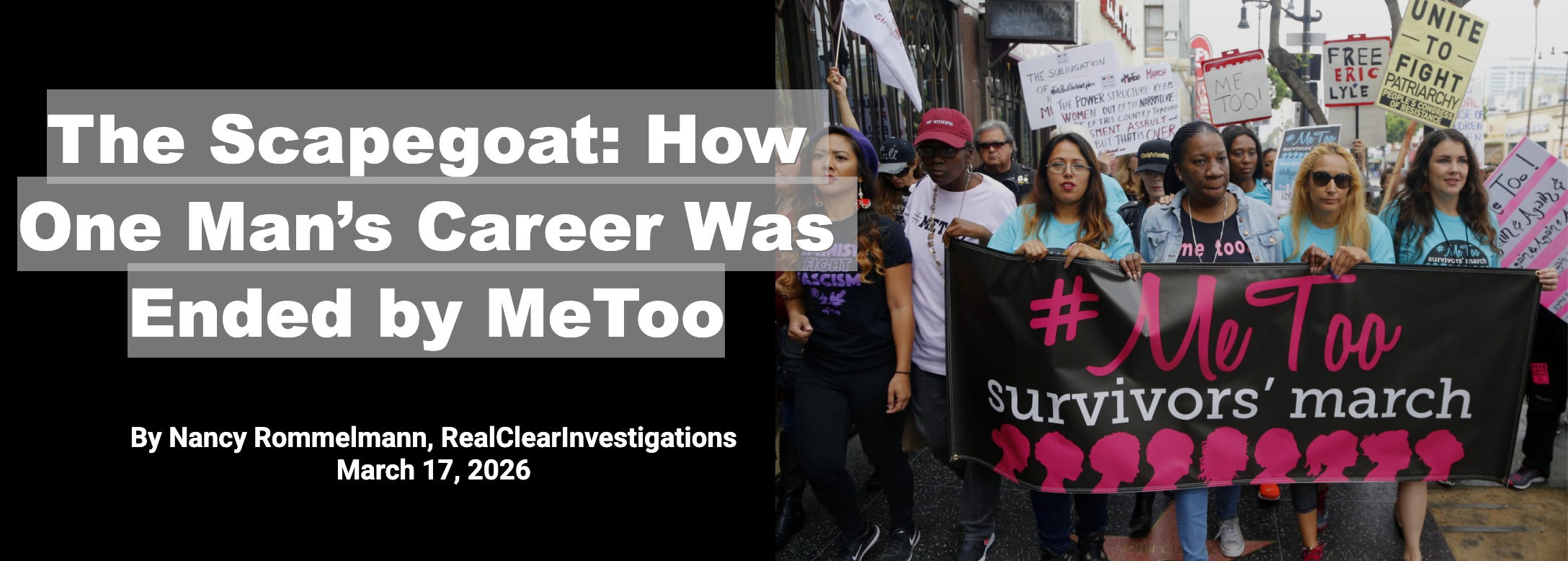
Life on Jan. 9, 2020, was interesting for Joshua Helmer. At 31, he was midway through his second year as CEO of the Erie Art Museum in Pennsylvania. He had recently secured the loan of a Chuck Close painting from the Philadelphia Museum of Art, and an upcoming sale, including a painting by another famous artist, David Hockney, would help Erie generate funds to buy new works.
And then it was Jan. 10.
“I knew I’d never work again,” Helmer said, recalling his reading of a New York Times article that ran that day.
“He Left a Museum After Women Complained; His Next Job Was Bigger,” was co-bylined by veteran Times reporter Robin Pogrebin and Zachary Small, then a freelancer. The article listed allegations from women against Helmer from his time as assistant director for interpretation at the Philadelphia Museum of Art (PMA), a position he said he resigned from a year-and-a-half earlier.
Nine women told the Times that Helmer made “advances” toward them, and four of these co-workers said they became romantically involved or lived with Helmer both during and after his tenure at PMA. The allegations ranged from the women being made to feel as though Helmer had the power to hold back their promotions – though none worked directly for him – to his yelling at them, insulting their intelligence, or saying things they found unnerving; a woman identified as “a former Philadelphia Eagles cheerleader” told the Times, “I worked in the NFL for five years and no one spoke to me in a way that made me feel that uncomfortable.”
There were no public allegations that Helmer directly pressured any of the women to have sex or engaged in any unwanted sexual behavior. He did allegedly suggest to one woman that she should “get to know him” to help her career, according to the Times.
There was one additional complaint from an Erie Art Museum female intern who provided the Times with a screenshot of a text Helmer sent, asking whether she wanted to have a coffee on the deck of his apartment, to which she replied, “No. Can’t sorry.”
Six years on, the fervor of MeToo has cooled. While some people brought down by MeToo gained a semblance of their previous standing, others, like Helmer, have not. He self-exiled to northern Pennsylvania, took up woodworking, and hasn’t worked again.
At the peak of MeToo, arguing that permanent banishment might be too much was a nonstarter. How could women (and some men) feel safe if those who sexually preyed on them were not shunned in ways that assured they could never prey on anyone else again? There was solidarity in seeing men get their comeuppance, a sense of pride for having the courage to come together with other women and speak up. That campaigns could get overheated, destroying the careers of some men whose actions, while sometimes troubling, might not deserve such harsh punishment, did not at the time seem worth considering. Who cared what happened to guys like Helmer?
A Weird Day
The Times did not paint Helmer as a 100% cad. “Women who dated Mr. Helmer said they were attracted to him at first because they found him warm, affectionate and confident,” the authors wrote. While all said the relationships had been consensual, each of Helmer’s accusers eventually felt undervalued, belittled, or suspected they had been retaliated against.
Although the women said they felt emotionally abused by Helmer, he never faced lawsuits stemming from their allegations. And while the Times insinuated some official wrongdoing – writing that “Mr. Helmer resigned for reasons that have not been disclosed” – Helmer told the newspaper he had left of his own accord. That his departure from PMA did not seem clearly connected to the women’s accusations made it all the more curious that the newspaper saw the story as worth running on Page 1 of the Arts section.
Or would have been curious, had it not been January 2020, when MeToo was at full velocity. Hundreds of well-known, powerful figures had and were about to lose their careers (Matt Lauer, Mario Batali, Kevin Spacey); some went to prison for charges as serious as serial rape (Harvey Weinstein, Bill Cosby, Danny Masterson).
Helmer was not accused of monstrous acts, nor was he well-known or powerful. He earned $70,000 a year at PMA. He was not executive-level and, according to a former department coordinator at PMA, did not have the authority to hire, fire, or promote, a detail that might have tempered the implied power imbalance the Times piece was in part predicated on.
Another detail that could have given the Times reporters pause came from the Erie Art Museum board president, who emailed the paper to say that, aside from the declined coffee invitation, “no other allegations had been brought to the board’s attention.” Nevertheless, the consequences for Helmer were immediate.
“The phone’s ringing off the hook nonstop. And that night we had an emergency board meeting,” Helmer said in an interview with RealClearInvestigations. “The board members came into my office, and they were like, ‘There’s just no way forward from this.’”
Without the institutional stamina to fight whatever might be coming their way, Erie accepted Helmer’s resignation on Jan. 13, after which, Helmer recalled, the board president drove him home. “We sat in the driveway, and I was like, ‘Wow, that was a weird day.’”
The weirdness continued. In the two months after Helmer left Erie, the Times ran four more pieces about the saga. Each article was co-bylined by Zachary Small, who had initially looked into Helmer for The Art Newspaper, an influential visual arts outlet where Small was then associate editor for investigations. The Art Newspaper, however, declined to run the Helmer piece because, as the paper’s editor recently told RCI, “The Art Newspaper only runs stories we can verify.”
Symbol of Male Dominance
The Times, on the other hand, evidently saw Helmer as part of a larger story about the male dominance of the museum world.
“This [story] was somewhat informed by a much larger culture of patriarchy at these institutions,” Robin Pogrebin said on the podcast Museum Confidential, four days after the Times ran the story detailing Helmer’s exit from Erie. “I think it’s important to think about this as a referendum on the industry to some extent and how important it is to have more balance in terms of gender.”
If the aftereffects came quickly for Helmer, they also came for Small, who, up until the Helmer piece, had contributed two pieces to the Times. In 2020, Small (who uses they/them pronouns) had 41 bylines in the paper. In 2023, they became a staff writer.
Which might have been the end of the story but for an incident in November 2025, when the then-CEO at the Philadelphia Museum of Art was fired, thus dragging Helmer’s name back onstage.
“I’m like a recurring character in a sitcom or soap opera,” Helmer said. “The [audience] is like, ‘Oh, we thought he was kicked in the head by a horse. Oh, he’s back!’ You make these small cameos. And then to see another piece added on five years later... it’ll never be done.”
The Maw of MeToo
There are many essential reasons to uncover the rot that historically allowed sexual misconduct to be swept away. Two reporters rightly celebrated for their MeToo coverage were Jodi Kantor and Megan Twohey at the Times, whose 2017 expose, “Harvey Weinstein Paid Off Sexual Harassment Accusers for Decades,” won the 2018 Pulitzer Prize for Public Service for detailing the sexual crimes of the powerful head of Miramax Films. This was important work, revealing the power imbalance felt by many women in Weinstein’s orbit, a disparity that could lead to fear – of having one’s career sabotaged and for one’s personal safety – and acquiescing to Weinstein’s demands for sex. It was also careful work. According to two high-level employees at the Times, when the Weinstein expose ran, Kantor and Twohey did not include several accusers whose stories they did not feel could be made watertight.
Three years later, such care at the paper appeared to have slackened. Perhaps the maw that was MeToo needed to be fed. Perhaps the incentives for breaking a big new MeToo story in an arena where there had not been one were too tempting.
“We’ve been wondering, in the museum community, when this would land on this industry,” said Jeff Martin, host of the Museum Confidential episode featuring Pogrebin and Small. Small responded that they had “received an anonymous tip telling me to look into the Philadelphia Museum of Art.” The tip would have been around September 2019, more than a year and a half after Helmer left PMA. Nevertheless, on Nov. 13, Small sent Helmer a 700-word email, with the subject line, URGENT PRESS REQUEST, and giving Helmer 48-hours to respond to 23 detailed questions.
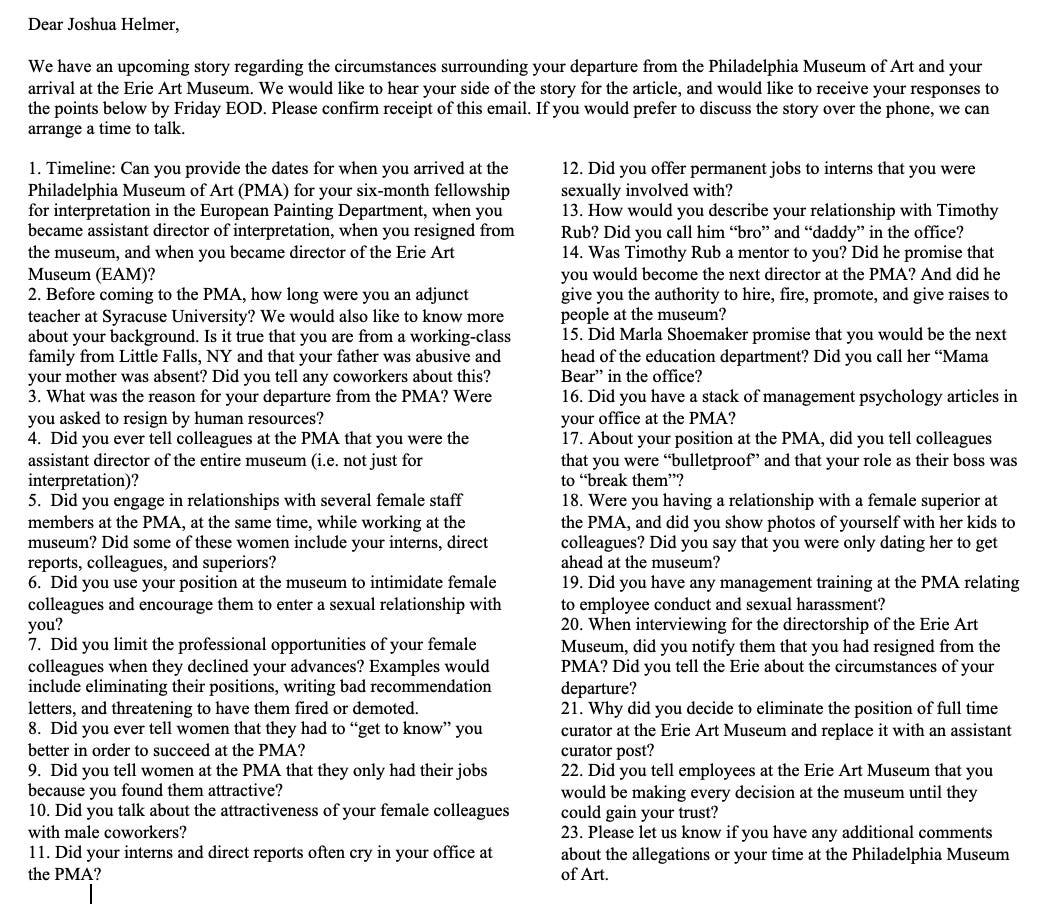
Journalists do not, as a rule, send cold interview requests this demanding, not if they are hoping for a reply. That Small sent it concurrently to several of Helmer’s former colleagues at PMA, as well as to the boards of PMA and Erie, seemed to Helmer very much like a trap.
“I was really quite shocked,” he said.
Fallout Becomes Opportunity
Whether Small intended to throw into turmoil the staff of both museums, that is what happened. On Nov. 14, Marla Shoemaker, then PMA senior curator of education, called a department staff meeting the next day. According to someone at the meeting who took contemporaneous notes, nearly two dozen museum staff showed up. Nancy Brennan, head of Human Resources, opened the meeting by saying, “We are going to address the elephant in the room.”
What elephant? the attendee recalled thinking.
Brennan said the museum could not disclose why Helmer left PMA, but to put to rest speculation, there had never been any claim of sexual harassment during his time there. Brennan and Shoemaker went on to discuss ways to make the staff feel supported, such as a commitment to a strict “no-retaliation policy” for staff who came forward with complaints.
This was apparently insufficient for Adam Rizzo, a museum educator who called Helmer “a sociopath” and demanded he be banned from the museum due to staff still being affected by “the situation,” according to meeting notes. To at least one attendee, Rizzo’s comments about Helmer seemed preloaded. Alicia Parks – the former NFL cheerleader – seconded not wanting Helmer on museum property, a request Shoemaker said she would work on with security.
Other former colleagues were at a loss. They had never felt threatened by Helmer. And what was “the situation” Rizzo referred to?
Since at least May 2019, Rizzo had been trying to rally support to form a union, according to an article in Philadelphia Magazine. Helmer now seemed to play a role in Rizzo’s union strategy. “Welcome” materials sent to prospective members and obtained by RCI called out “Patriarchy, misogyny, racism, ageism and other-isms in institutional culture,” and named Helmer as an example of a “Culture of silencing and enabling.”
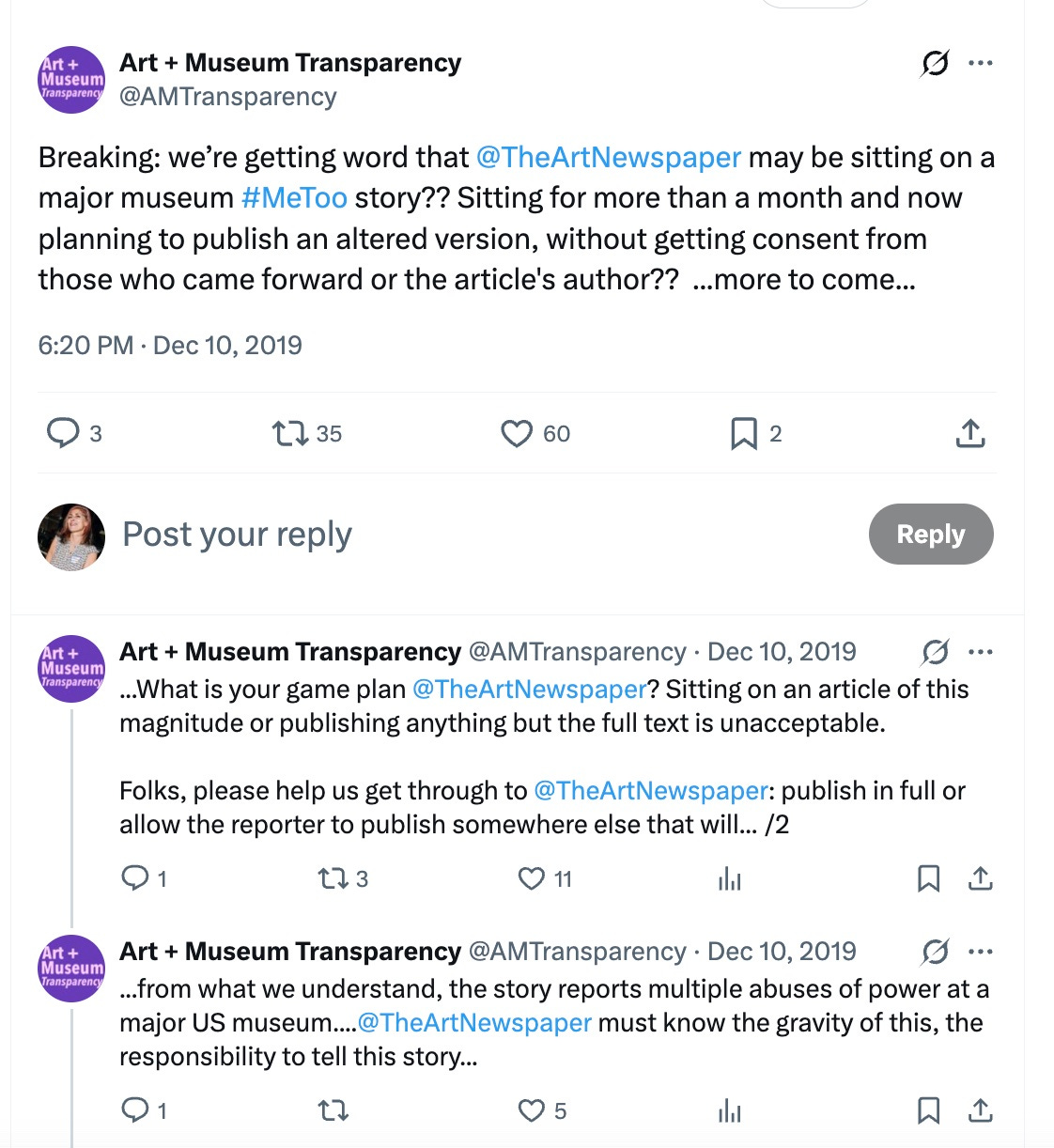
A short-lived Twitter account with the handle @artandmuseumtransparency repeatedly posted tweets such as, “We’re getting word that @TheArtNewspaper may be sitting on a major museum MeToo story?? Sitting for more than a month and now planning to publish an altered version, without getting consent from those who came forward or the article’s author??” Rizzo told one meeting attendee he had “emailed the reporter” and was hoping to hear back soon, and later made Instagram posts about PMA needing a union and disparaging Helmer specifically.
It remains unconfirmed whether Rizzo was the anonymous source who got Small interested in Helmer. Reached for comment about the Helmer affair, Rizzo told RCI, “Not interested.”
Meanwhile, at the Erie Art Museum, Helmer did not reply to Small’s lengthy email. He said he forwarded it to Lucia Conti, director of marketing at Erie, who agreed it was best to ignore it. While Helmer could not say if Small wanted to take him down, he considered whether the several women at PMA he’d been romantically involved with, at times concurrently, might have wanted to.
According to Helmer, his most serious relationship had been with Rachel Nicholson, who had lived with him in Philadelphia during part of their time at PMA and moved with him to Erie. Helmer said the relationship did not work out in part because Nicholson learned he had been unfaithful. The former couple had not been in contact for more than a year when he received a text from Nicholson in December 2019, saying she was looking forward to an article about him in the New York Times.
Within a week, Helmer was contacted by Pogrebin, asking to interview him. With Conti in his office, Helmer spoke with the reporter, who, according to notes Conti took at the time, seemed “audibly disappointed” not to be speaking to Helmer alone. Pogrebin asked Helmer about dating PMA staff and stated that doing so was “problematic.” Helmer countered that he had “followed PMA policy.” Pogrebin said several staff members said he “displayed harassing behavior.” Helmer said that he was unaware of such claims and wondered why, after nearly two years away from PMA, the Times was interested in him now. According to Conti’s notes, the Times reporter said it was because “so many women were damaged by your behavior and it involves a large institution.” Pogrebin did not reply to an email from RCI asking for comment.
The conversation lasted less than 15 minutes. When Pogrebin said she would be back in contact with Helmer, Conti assured her that in any future discussions, “the answers to the questions you have asked us today will be the same.”
Celebrating Helmer’s Downfall
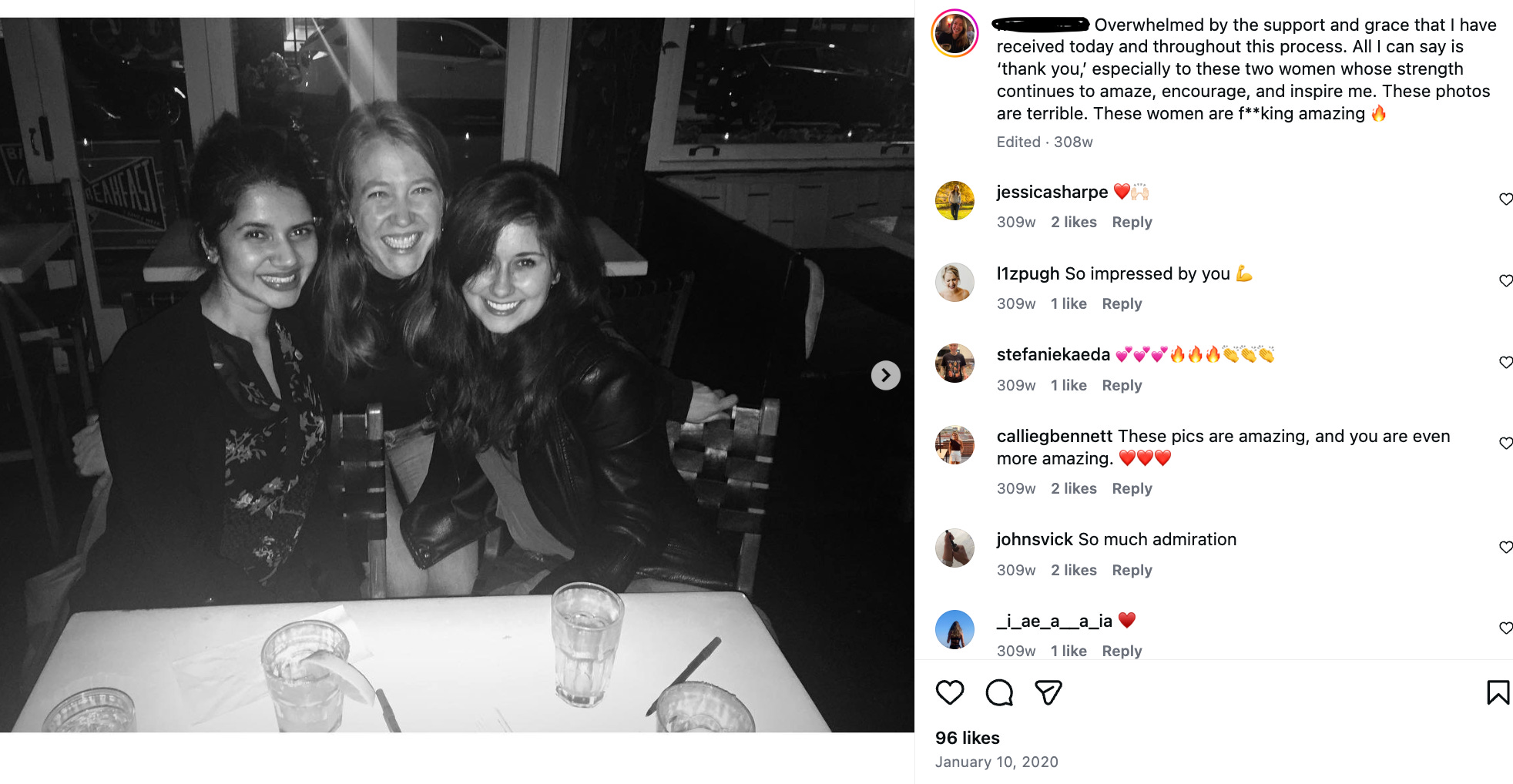
There were no future calls. On Jan. 10, the Times ran its first story on Helmer. That same day, a woman Helmer had never met started a petition on Change.org titled, "Stop The Abuse And Predation: Fire Joshua Helmer, Erie Art Museum." That evening, Nicholson posted an Instagram photo of herself having celebratory drinks with two of the other women in the Times piece who had also dated Helmer, with a caption that read in part, "Overwhelmed by the support and grace that I have received today and throughout this process." The responses to the photo were full of admiration and heart emojis.
They were not feeling the love at PMA. On Jan. 14, the education department called another meeting. According to notes taken by an attendee, CEO Timothy Rub said he had received two complaints about Helmer’s behavior while he worked at PMA, the details of which he said he could not disclose. “Did we act?” he asked rhetorically. “Yes, on both accounts.” Although neither complaint resulted in discipline, Shoemaker, the curator of education, said the alleged behavior had happened on her watch and apologized for any harm Helmer had done. Rizzo stated he had previously seen “women and interns crying at their desks” and, since the Times article appeared, was “hearing more now online.”
Back in Erie, Helmer braced for further condemnation. In addition to several publications picking up the Times reporting and writing their own versions of the story, Pogrebin and Small published a fifth piece on March 10 rehashing the allegations against Helmer, after which the story either ran out of steam or was replaced by wall-to-wall coverage of the pandemic.
Several former colleagues urged Helmer to counter the accusations, perhaps even file a lawsuit. He declined. He did not reach out to any of his accusers, and never heard from any of them again. “In terms of fighting back. I always felt like, if I hurt you enough that this is what you felt was right, then the pound of flesh is yours,” he would later tell RCI.
Had the pound of flesh been what Helmer’s accusers wanted? Had they been swept up in the enthusiasm of MeToo? Six years on, RCI made contact with all but one of the women named in the article. Parks was asked if she might reveal what Helmer said that had made her “that uncomfortable.” Nicholson was asked about the support she had received. The woman who’d created the Change.org petition – which gathered 3,000 signatures in three days and, the day Helmer resigned from Erie, ran an update titled, “We did it! Helmer has been fired” – was asked why she had felt it important to start the petition. None of the women responded.
Maybe they want to put whatever happened with Helmer behind them. Several had moved on to different museums. At least one had gotten married and become a mother. Perhaps they did not want to revisit a painful chapter in their lives that, by speaking with the Times, had been at least partially relieved.
RCI also emailed Small, asking why they had gone so hard in their initial email to Helmer. They did not respond. A Times spokeswoman did, saying, “We publish what is newsworthy and what we are able to confirm.”
Art World Reckoning
Looking back to 2020, Jeff Martin, the Museum Confidential podcast host and director of communications for the Philbrook Museum in Tulsa, Oklahoma, saw a giant hunger for change, a reckoning on both sex and race, in a museum industry run mostly by white men.
“You could see that many institutions were pushing for more representation,” he told RCI. “If you’re looking to kind of leverage a moment, sometimes you get caught up in it... If you see something that can lift you six inches higher to the top of the fence you’re trying to climb, you’re probably going to step on that thing.”
As for Helmer specifically, Martin had not heard of him before the Times pieces. He did know more about PMA’s recent controversy, having been at a conference of museum professionals in Philadelphia on Nov. 4, 2025, when the firing of PMA CEO Sasha Suda was announced.
“Everybody’s phone starts going off like some weird scene from a movie,” Martin said, a firing at first attributed to disappointment with Suda’s recent changing of the museum’s nickname from PhAM to PhArt – a rebranding people understandably had a field day with – and later to accusations that Suda had given herself unauthorized raises. As the story moved into the courts and was dutifully reported, including in the Times, the character that is Joshua Helmer was called back into action.
“What they’re talking about is not me. But then in the public, it is me,” said Helmer. “They’ve made up Josh Helmer, actually, because there’s no dimensionality to it at all.”
A ‘Zipper Problem’
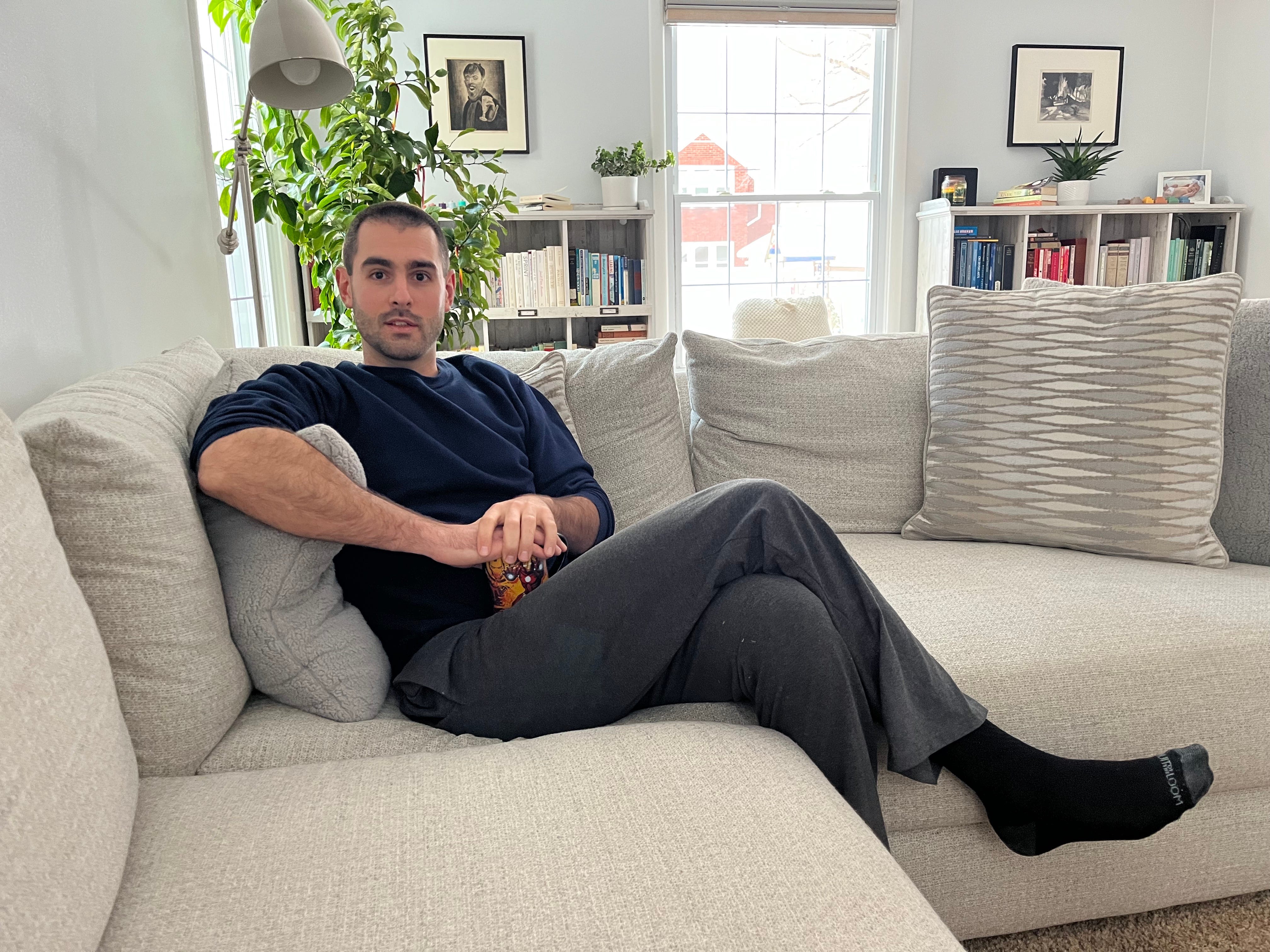
It was mid-December 2025. Helmer had just turned 37. Tall and lanky, with cropped dark hair, he had the politician’s habit of repeating your name in conversation. In the living room of the home he shares with his partner, a teacher, and her four school-age children, he explained he did not currently have a job, nor had he looked for one in the museum world.
“Honestly, I was done. I knew I was done. ‘Radioactive’ is the term,” he said. He had read the Jon Ronson book, “So You’ve Been Publicly Shamed,” and sensed, from Ronson’s reporting and from what Helmer could see from the many MeToo cases in the news, that neither defending himself nor apologizing would have anything but a negative effect.
“I am struggling sometimes to find what it is I am being accused of,” he said. “I definitely dated a couple of them simultaneously. Not cool. Got that. If I hurt your feelings, you got me. But it turned into this thing of sexual predator, and even when I read that [Times] article, I can’t find it.”
Helmer said he was fortunate to have invested well and thus did not need a job. “I’m a house husband now,” he said, mentioning that he did most of the cooking for the family and grew much of their produce in a massive garden. “I also taught myself how to make wood furniture by hand.”
He’d also had a lot of time to reflect. Having signed a non-disclosure agreement when he left PMA, he could not reveal the reasons for his departure, other than he’d perhaps been overambitious. One of his accusers told the Times he had told her he would one day be the head of the museum, and maybe he had said that. He had started climbing the ladder at PMA at 24 and moved fast.
He also moved fast with women, of whom there was never a shortage. The staff at American museums skews on average 60/40 female, with new interns and grant recipients coming in by the season. During Helmer’s time at PMA, nearly all these new employees were in their 20s and excited to be working at one of the best museums in the country. Mentioning several times that every one of the PMA colleagues he fooled around with was “very interesting, very smart, very cool,” he also seemed tickled at the suggestion that he had a zipper problem.
“I did, I had a zipper problem,” he said. “I had a lot of girlfriends. Lots of girlfriends.”
Still, he did not think his sleeping around was the main driver of the campaign that took him down. “I thought it was about the union,” he said. “They were having trouble drumming up the support they needed. They needed reasons to say, ‘Our workplace isn’t safe.’” The lack of a statement as to why he’d left the museum was perhaps too good a moment to pass up, for a union organizer to rally support, for an eager reporter to further make their bones. Many things can swim into opportunity.
While several of Helmer’s former girlfriends told the Times positive things about him – and in person he seemed effortlessly at ease, someone who could make you feel fully seen when he put you in his high-beams – the lasting picture was of a man who only saw you when it suited him, someone who spoke to a former NFL cheerleader in a way that made her feel very uncomfortable, a woman Helmer says he has no recollection of meeting.
“When this article came out, I called the PMA and was like, ‘Who is Alicia Parks?’” he said. “I’d love to know what I said to her.”
Helmer said he was ready to take “full accountability” for what happened. “I shouldn’t have done what I did... mixing business and personal, dating multiple people at the same time,” he said. Still, he would prefer that anytime his name is Googled, the first hits are not always about his alleged mistreatment of women. “I have been vanquished. I am enjoying my exile in the northwestern corner of Pennsylvania,” he said. “Leave me alone.”
Nevertheless, Helmer said there is one piece of unfinished business. “I just want a retraction that [the Times article] was in a clearly false light in a hundred ways,” he said. “I’ll never go back to my job. I’ll never go back to that life. I just want a retraction, and I’ll hang it in the kitchen.”
The spotless kitchen, which, six years after his last paying gig, he repaired and unwrapped a slab of homemade spinach pasta dough.
“It’s like I’m a Frankenstein, but not a Frankenstein,” he said, rolling the dough with a controlled intensity. “I mean, there are so many times that I had to sit at home and be like, am I a monster?”
Fascinating. And very interesting to see the erosion of standards from Kantor / Twohey’s (Gen Xers and definitely she/hers) work to the they/them’s standards.
And the parallel union angle: the NYTs had its own activist union issues. Did this play into editors’ willingness to hold a they/them to traditional (non- activist) journalist standards?
I know this is a story about the over application of #metoo and the long standing and regrettably human tendency to engage in witch hunts.
But also curious about how the NYTs inability to confront gender ideology has played into the story.
#free Britney Spears to free the world.